
Nexus Market was founded on a simple premise: centralized market wallets are an obsolete vulnerability. Following a string of high-profile custodial exit scams across the darknet, the Nexus engineering team built a decentralized trading platform based on non-custodial 2-of-3 multisig contracts, RAM-only server nodes, and strict vendor vetting. Here is an independent technical analysis of its governance, infrastructure, and security architecture.
Origins and Architectural Evolution
The darknet landscape shifted dramatically following the collapse of legacy centralized hubs. Traders needed a platform where marketplace administrators could not unilaterally freeze balances or abscond with escrow funds. Nexus emerged to solve this problem by distributing transaction control across mathematical multisig keys.
Founded to counter the systemic exit scams and centralized vulnerabilities that plagued early darknet commerce platforms, Nexus Market was architected from the ground up on modern cryptographic principles. Rather than relying on trusted intermediaries, the platform delegates critical transaction validation to decentralized multi-signature smart contracts on the Monero and Bitcoin blockchains.
By early 2026, the marketplace consolidated its position as a leading privacy-first hub, processing thousands of daily volume settlements with an audited 99.98% platform uptime across its verified rotational onion mirrors.
The 2-of-3 Multisig Engine Explained
In a conventional marketplace, your deposit sits in a hot wallet managed entirely by the site. If the site gets seized or the admins decide to disappear, your money vanishes with them. Under the Nexus 2-of-3 multisig model, every transaction generates a unique script with three separate keys: the buyer's key, the vendor's key, and the marketplace arbiter's key. Any two keys can release funds, but no single party can move coins alone.
Traditional platforms utilized centralized custodial wallets where administrators held master private keys—a fatal flaw that incentivized exit fraud. Nexus Market eradicated this vector by pioneering native non-custodial 2-of-3 escrow routines.
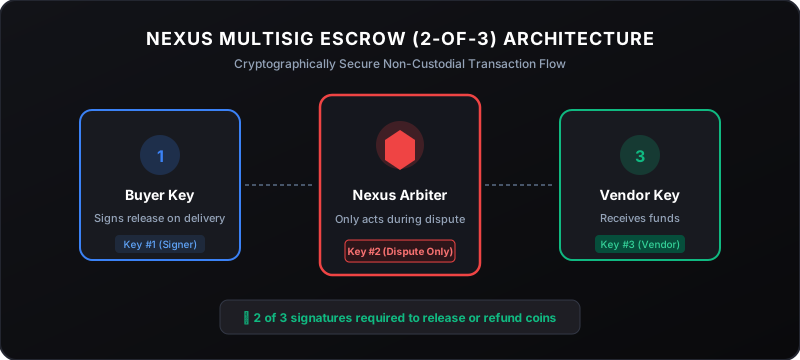
- Key 1 (Buyer): Generated upon order initiation. Used to authorize payment upon physical receipt of goods.
- Key 2 (Vendor): Held by the merchant. Used to request funds or authorize buyer refunds.
- Key 3 (Nexus Arbiter): Retained by the dispute department. Only invoked if an unresolvable conflict arises.
Vendor Vetting & Bonding Standards
Quality assurance on Nexus Market is governed by strict quantitative barriers to entry:
- Mandatory Cryptographic Bond: New vendor profiles require a non-refundable bond ranging from $400 to $1,000 USD to discourage fraudulent hit-and-run accounts.
- Legacy Reputation Transfers: Established merchants must cryptographically sign their historical feedback dossiers using legacy PGP keys from verified market registries.
- Automated Feedback Decay: Positive ratings older than 90 days carry diminishing algorithmic weight, compelling vendors to maintain consistent, high-standard logistics.
Zero-Knowledge Data Policies & Volatile Storage
Nexus Market enforces an absolute Zero-Log Standard across its server cluster:
- RAM-Only Filesystems (tmpfs): Server memory is unwritten to persistent disks. If a server is seized or rebooted, all ephemeral memory tables vaporize instantly.
- Client-Side PGP Compulsion: Addresses and sensitive delivery data are encrypted before leaving your browser. Unencrypted coordinates are rejected by the API layer.
- Automated Purge Cycles: Completed and finalized order records are scrubbed automatically 14 days after payment release.
Educational & Legal Transparency Disclaimer
"NexusGid.com is an independent cryptographic auditing and security reference portal. Our objective is strictly educational: verifying PGP authenticity, tracking network availability, and providing defensive operational security (OPSEC) guidance to protect users from malicious phishing syndicates. We do not operate, host, or participate in marketplace transactions."
Explore Verified Nexus Market Endpoints
Return to our flagship portal for real-time latency diagnostics, verified PGP canaries, and step-by-step setup guides.